Wet End Equipment
Headbox System
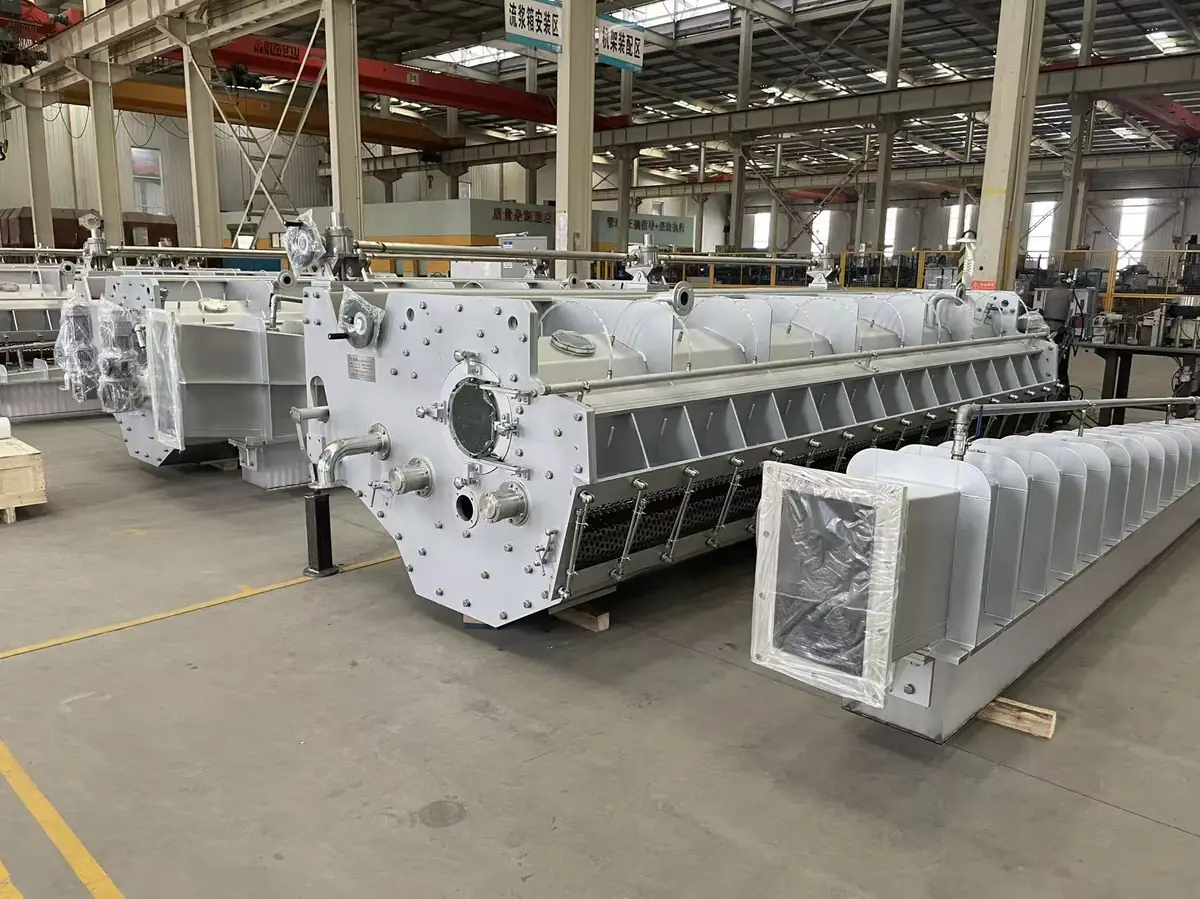
A headbox distributes prepared stock evenly across the forming width and delivers a stable, turbulence-controlled jet to the wire for better sheet formation and basis weight profile.
Product Introduction
The headbox is one of the most important components in the forming section. Its job is to convert the approach-flow stock into a uniform jet across the full machine width, control fiber dispersion, and help stabilize the CD basis weight profile. Selection depends on paper grade, machine speed, wire width, furnish, consistency, and the level of profile control required.
Typical Supply Scope
- Hydraulic or air-cushion headbox body matched to machine speed
- Tapered manifold, turbulence generator, slice lip, and distribution chamber
- Manual, motorized, or dilution-type CD profile adjustment as required
- Stock inlet, overflow, dilution water, cleaning, and inspection connections
Application Notes
For low-speed machines, an air-cushion or open-type headbox may be suitable. For medium and high-speed paper machines, a hydraulic headbox is usually preferred because it provides more stable jet velocity, better turbulence, and stronger formation control.
| Parameter | Typical Selection Range |
|---|---|
| Headbox type | Open type, air-cushion type, hydraulic type, or dilution hydraulic type |
| Applicable paper grades | Kraft paper, testliner, fluting, culture paper, white board, specialty paper, and tissue lines by design |
| Machine speed | Open / air-cushion: approx. 80-350 m/min; hydraulic: approx. 300-800+ m/min, customized for higher-speed projects |
| Net paper width | Approx. 1,880-5,800 mm common range; wider machines designed according to project requirements |
| Slice / jet width | Designed according to wire width and trim width, with adjustable upper lip for flow profile correction |
| Headbox consistency | Typically 0.2-1.2%, finalized according to furnish, grade, basis weight, and approach-flow design |
| Basis weight range | Approx. 35-250 gsm for common paper grades; board and specialty grades configured separately |
| Jet-to-wire ratio | Adjustable around the wire speed, commonly controlled near 0.97-1.03 depending on grade and formation target |
| CD profile control | Manual slice adjustment, motorized slice adjustment, or optional dilution water CD control |
| Main material | Stock-contact parts commonly stainless steel 304 or 316L, selected according to process and corrosion conditions |
| Key design focus | Uniform stock distribution, stable jet velocity, controlled turbulence, easy cleaning, and reliable profile adjustment |